
A Beacon of Hope, The Antarctic Ozone Hole Shrinks Significantly in 2025
In a resounding success story for global environmental cooperation, the Antarctic ozone hole in 2025 was one of the smallest and shortest-lived in recent decades.
Kyllo
12/29/2025
A Beacon of Hope: The Antarctic Ozone Hole Shrinks Significantly in 2025
In a resounding success story for global environmental cooperation, the Antarctic ozone hole in 2025 was one of the smallest and shortest-lived in recent decades. Scientists from NASA, NOAA, and the European Copernicus Atmosphere Monitoring Service (CAMS) have confirmed that this year’s depletion was markedly reduced, offering reassuring evidence of the ozone layer’s ongoing recovery.
The 2025 Ozone Hole: Key Facts
The annual ozone hole over Antarctica forms each southern spring due to cold stratospheric temperatures and lingering ozone-depleting substances (ODS). In 2025:
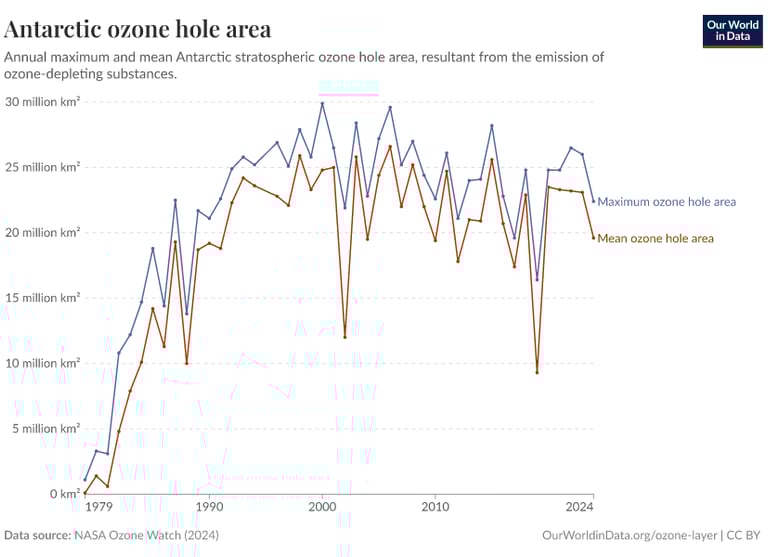
• The hole reached its maximum single-day extent on September 9, covering 8.83 million square miles(22.86 million square kilometers).
• During the peak depletion period (September 7 to October 13), the average area was approximately 7.23 million square miles (18.71 million square kilometers), about 30% smaller than the record large hole in 2006.
• NASA and NOAA ranked it as the 5th smallest since 1992, when the Montreal Protocol’s phase-out of ODS began taking effect.
• Using the full satellite record since 1979, it ranked as the 14th smallest in 46 years.
• The hole closed on or around December 1, the earliest since 2019, making it the smallest and shortest-lived in five years, according to CAMS.
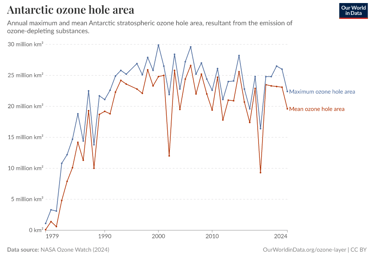
These graphs show the long-term trend in Antarctic ozone hole area, highlighting the decline since the early 2000s and the relatively small 2025 hole (red line in recent Copernicus data).
Looking Ahead: Full Recovery on the Horizon
Projections indicate the ozone layer will return to 1980 levels (pre-hole era) by around 2066 over Antarctica, earlier elsewhere. The 2025 results, following a string of larger holes from 2020-2023 influenced by events like volcanic eruptions, confirm the long-term healing trend.
As Laurence Rouil, Director of CAMS, stated: “This progress should be celebrated as a timely reminder of what can be achieved when the international community works together.”
In an era of complex climate challenges, the shrinking Antarctic ozone hole stands as proof that decisive, science-based global action can mend planetary damage. The ozone layer’s recovery is a victory for science, diplomacy, and the environment, protecting life on Earth from harmful UV radiation for generations to come.
News
Stay updated with the latest news headlines daily.
© 2024. All rights reserved.